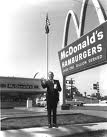
Ray Kroc was born in 1902. It was a time in America where men and women were increasingly trying their hand at entrepreneurship. The country had moved out of the dark ages and these people wanted to lead from the front. It was the age of William Durant and Henry Ford. It was the age of the great nation builders.
Young Ray Kroc believed that opportunity only knocked once and took his chances as they came. When he was fifteen years old he lied about his age and landed himself the job of an ambulance driver for Red Cross. After that he tried his hand at a myriad things, finally settling down to be a salesman. He initially sold paper cups. Opportunity knocked on his door when he had a chance meeting with Earl Prince, the inventor of the five-spindle multimixer. Ray Kroc convinced Earl to give him exclusive marketing rights for the mixture and successfully sold it all over the country for the next decade and a half.
As he traveled all over the country, he realized that one of his largest customers was a California based restaurant owned by the McDonald brothers. On further enquiry he found out that they used a mass production cum assembly line system for their hamburgers and sandwiches. The owners were not interested in expanding the operation further and seemed content with present operations. In another display of salesmanship Ray Kroc convinced the brothers to make him their exclusive agent. In 1954 Ray Kroc opened his own McDonald's drive-in in Des Plaines, Illinois. He officially established the McDonald's Corporation.
It was not an easy time for Ray Kroc. He was suffering from diabetes and arthritis. His gall bladder and thyroid gland had already been surgically removed. But the desire to succeed burnt throughout his body. In a final act of refined salesmanship Ray Kroc managed to convince the brothers to sell the company to him. He asked them to name their price. The $2.7 million that Ray Kroc paid in 1961 for the McDonalds Corporation is considered to be one of the greatest acts of salesmanship of all time.
While running McDonalds he realized that a big chunk of the profits would come from the land on which the franchisees are established. In 1956 Ray Kroc set up the Franchise Realty Corporation, which bought land and leased it out to franchisees. Post 1961, Ray Kroc began recruiting franchisees at a feverish pace. The revenues that the company received from the franchisees made it easier for Kroc to raise capital in the financial markets. He utilized some of the money to create an enduring advertising campaign that centered on the company’s mascot – Ronald McDonald.
Once the domestic market was saturated with McDonald’s franchisees, Ray Kroc turned his attention overseas. It has opened outlets in more than sixty-five countries. McDonald’s tailor-made its offerings depending on the country in which it was operating. In order to make the chain's name more easily pronounceable for Japanese consumers, it was changed to Makudonaldo. In India and in the Middle East, pork is not served. In Ireland the promotions proclaimed, "Our name may be American, but we're all Irish."
Today most companies who operate in the service industry have pricked up something or the other from the McDonalds way of functioning. They have learnt that ray Kroc was right when said that, "The organization cannot trust the individual; the individual must trust the organization." Non-conformists did not find any place in his plans. Ray Kroc constantly harped on the need for minute labor specialization and definition of the company’s value proposition.
After handing over the operations to Fred Turner in 1968, Kroc began to take a macro view of the organization that he built from scratch. He continued to monitor business of the newer franchisees. His paranoia regarding the success of McDonalds was intact as ever. Whenever he traveled he insisted that his chauffer drive him to at least six franchisees for him to conduct surprise checks. In 1977, Ray Kroc became the Senior Chairman. McDonald's had sold 65 billion hamburgers by 1987, the year before it opened its ten thousandth store. McDonald's now opens about one-third of its new restaurants in foreign markets.
In 1974, Ray Kroc became a hero for reasons completely unrelated to business. He purchased the San Diego Padres baseball team and prevented them from moving to Washington, D.C. Ray Kroc passed away from old age in January 1984, at the age of eighty-one, just the ten months before McDonalds sold hamburger number fifty billion.


